Holidaypac
 Oct 07,2026

"How much will a custom cardboard display cost?" is the first question almost every brand asks us — and the honest answer is: it depends on about seven decisions you make before the first sample is cut. The short answer first: at Holidaypac, most custom cardboard displays cost between US$10 and US$30 per unit, with a minimum order of just 200 pieces. This guide walks through each of those decisions, shows how much each one moves the price, and explains how ordering factory-direct with DDP delivery changes the total landed cost. Whether you are planning a counter display for a pharmacy chain or a full pallet program for a big-box retailer, you will finish this article knowing exactly what drives your quote and where you can save.
A point-of-purchase (POP) display puts your product in front of shoppers outside the crowded shelf — at the checkout, on an end cap, or in the middle of the main aisle. Corrugated cardboard has become the default material for these programs because it is light, prints beautifully, ships flat, sets up in minutes, and is curbside recyclable. Compared with metal, wood, or acrylic fixtures, a cardboard display costs a fraction as much per unit, which is why it dominates short-term promotions, seasonal resets, and product launches.
But "cheap per unit" does not mean every cardboard display costs the same. A small easel card and a four-sided pallet display are both "cardboard displays," yet their prices can differ by more than ten times. Understanding why is the key to building an accurate budget.
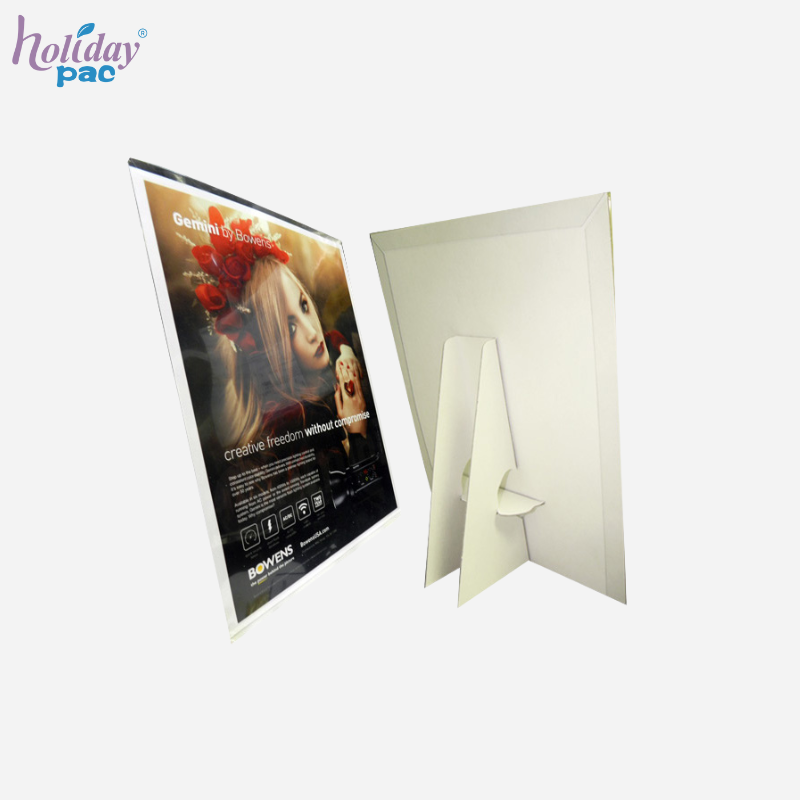
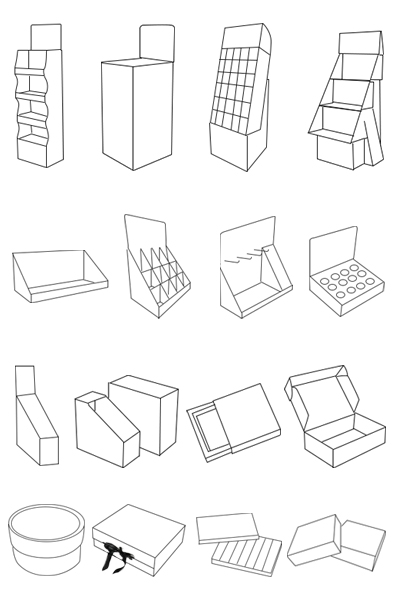
The type of display is the single biggest driver of price, because it sets how much board, printing, and assembly each unit needs. From lowest to highest cost, the main formats are:
Each step up adds board area, print surface, internal reinforcement, and hand-assembly time. As a rough rule, a floor display costs several times as much as a counter unit, and a fully printed pallet display sits at the top of the range. For reference, the majority of the custom displays we produce land in the US$10–30 per unit range, depending on size, structure, and print.
Your product decides how strong the display has to be. Lightweight items such as greeting cards, snacks, or cosmetics can sit on standard single-wall board. Heavy items — bottled drinks, motor oil, footwear — need double-wall board, extra shelf supports, or honeycomb panels.
Stronger board and more internal supports mean more material and more assembly labor. Product size also decides shelf depth, the number of shelves, and the number of facings, which together set the overall dimensions of the unit. Our corrugated pallet display with 6-grid dividers for shoes is a good example of a display engineered around a heavy, bulky product.
If you are unsure which board grade you need, our corrugated flutes guide explains the difference between A, B, C, E, and F flutes and when to use each.
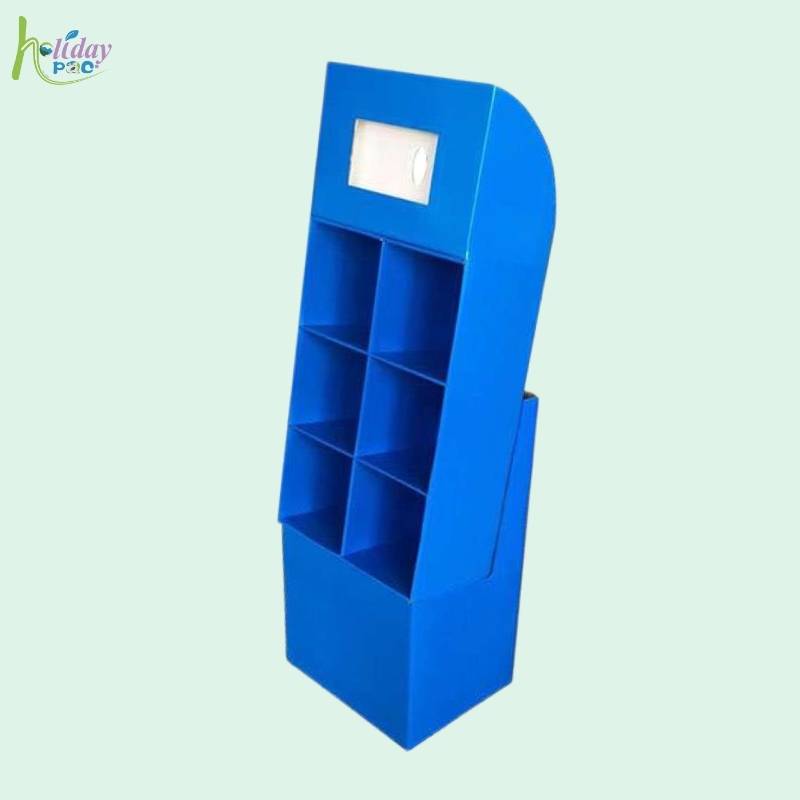
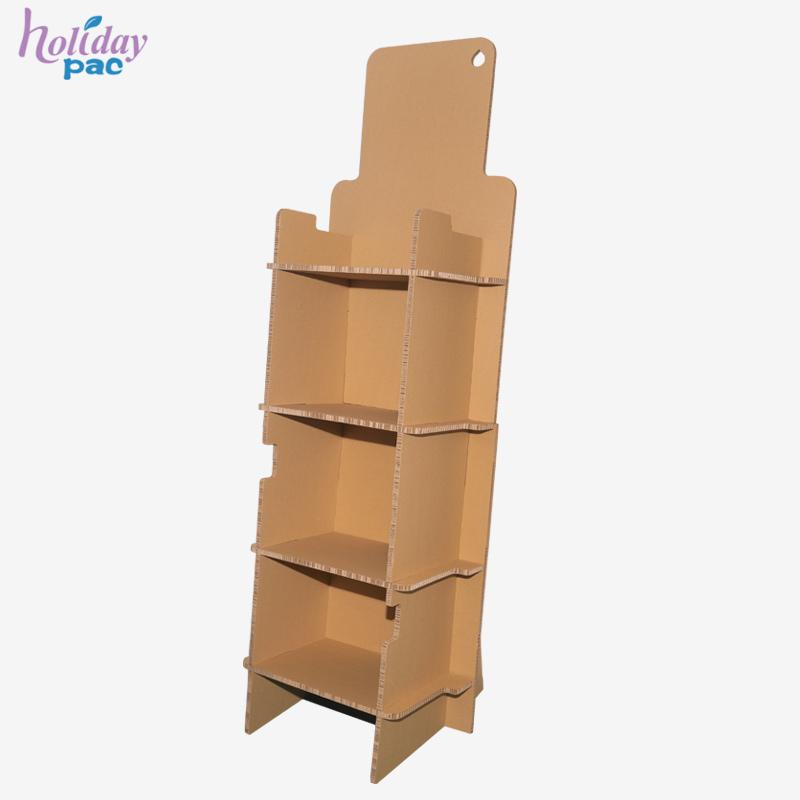
Beyond board grade, the structure itself affects cost. Simple fold-and-lock designs with few parts are fast to assemble and cheap to produce. Complex shapes, curved headers, die-cut cut-outs, hooks, dividers, and add-on elements such as power wings or shelf talkers all add steps.
Material choice matters too. Honeycomb board, like the panels in our honeycomb cardboard floor display for skateboards, carries heavy loads with less material weight, but it costs more per sheet than standard corrugated.
A good structural engineer will often find a way to hit the same strength with fewer parts — one of the easiest ways to bring a quote down without changing how the display looks on the shop floor.
Graphics are what make a display sell, and they are a major cost line. The main variables are:
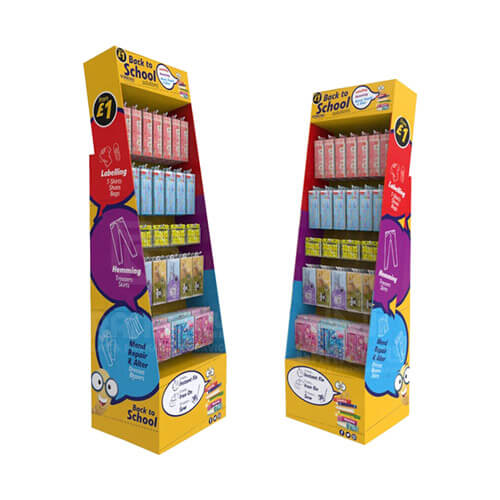
Bold, seasonal graphics — like this back-to-school pen floor display — are worth the investment when the promotion window is short and you need to stop shoppers fast.
The dieline is the flat blueprint of your display — every cut line, fold line, and glue flap. If you already have a dieline that fits your product, you skip the structural design step. If not, our engineers design the structure and the dieline for you — one of the biggest advantages of working with Holidaypac. Many suppliers only quote on your drawings; we create the display solution itself.
Our sampling process is simple and fast:
Tooling is a one-off cost: once the cutting die is made, re-orders of the same display only pay for board, print, and assembly. With a 200-unit MOQ, you can test a design in a limited number of stores before committing to a national rollout.
Every display run carries fixed costs: structural design, tooling, printing plates, and machine setup. Spread over 50 units, those costs are heavy; spread over 5,000, they almost disappear. That is why the unit price drops steeply as quantity rises. Holidaypac's MOQ is 200 units: at that quantity, a typical custom display costs a little over US$20 per unit, and the price comes down further as volumes grow. For a step-by-step breakdown of minimums, sampling, and production timelines, see our cardboard display MOQ and lead time guide.
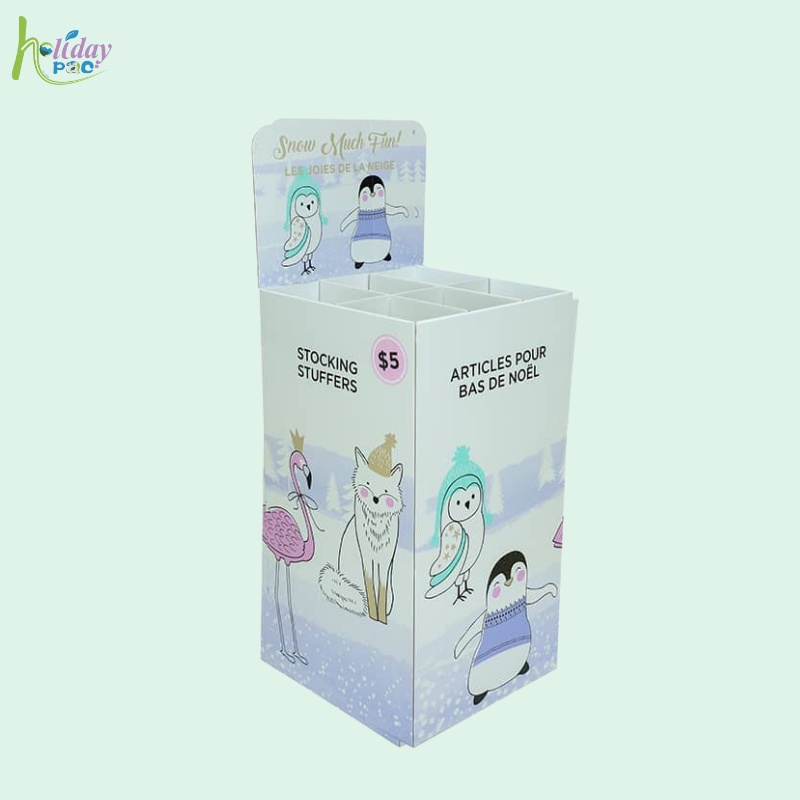
When you plan quantity, count every store in the program, plus a buffer for damaged units and late additions. If you plan to give displays to retailers free as a sell-in incentive, include those too. Seasonal programs such as our Christmas stocking stuffers pallet display are usually ordered in one large run, which keeps unit cost low.
The quote on paper is not the cost you pay. Freight, customs clearance, import duties, and last-mile delivery can add a large share on top of the factory price — and those costs are often left out of early comparisons.
Cardboard displays help here because they ship flat and stack densely on pallets. Ordering from a factory-direct supplier usually gives a much lower unit price than a domestic converter, and the main question becomes logistics. Holidaypac solves that with door-to-door DDP delivery: we handle ocean freight, customs clearance, and duties, and you receive one all-in price delivered to your warehouse or co-packer. No surprise invoices at the port.
Prices are typical ranges for reference. Your exact quote depends on the factors above.
Big-box and grocery chains set their own rules for displays: maximum height, footprint, pallet size, load testing, and set-up instructions. A display that misses these specs can be rejected at the store — the most expensive outcome of all.
Always ask your buyer for the current display guidelines before design starts. Holidaypac has built display programs for retailers such as Target and Walmart, so our engineers design to these specifications from the first sketch. Our supermarket pallet display is built to fit standard pallet footprints and shopper sight lines.
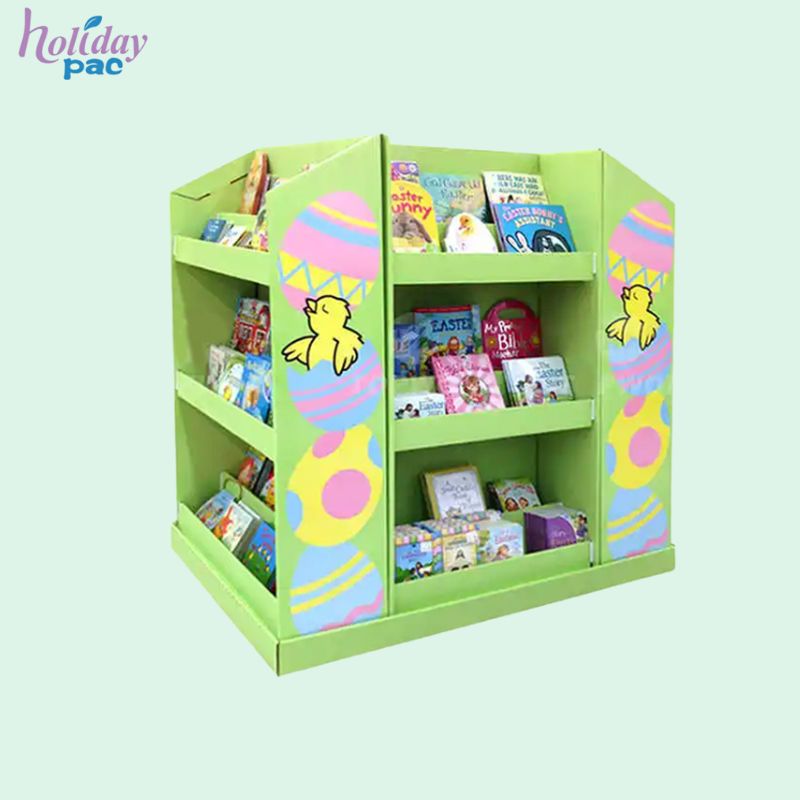
Timing matters too. Spring and Easter resets are planned months in advance, so the fourth quarter is the right moment to start sampling for next year's first-half promotions.
More retailers now ask suppliers to prove where their paper comes from. For displays sold into Europe, the EU Deforestation Regulation (EUDR) requires deforestation-free, traceable sourcing for paper and board. FSC-certified board is one of the most practical ways to document this.
Holidaypac's factories work with FSC-certified materials and are held to EUDR and PPWR requirements, alongside BRC, BSCI, SGS, ISO, SEDEX, and FDA certifications. For most projects, choosing certified board adds little or nothing to the unit price — and it removes a compliance risk later. Read more in our article on why FSC certification is the new standard for sustainable packaging.
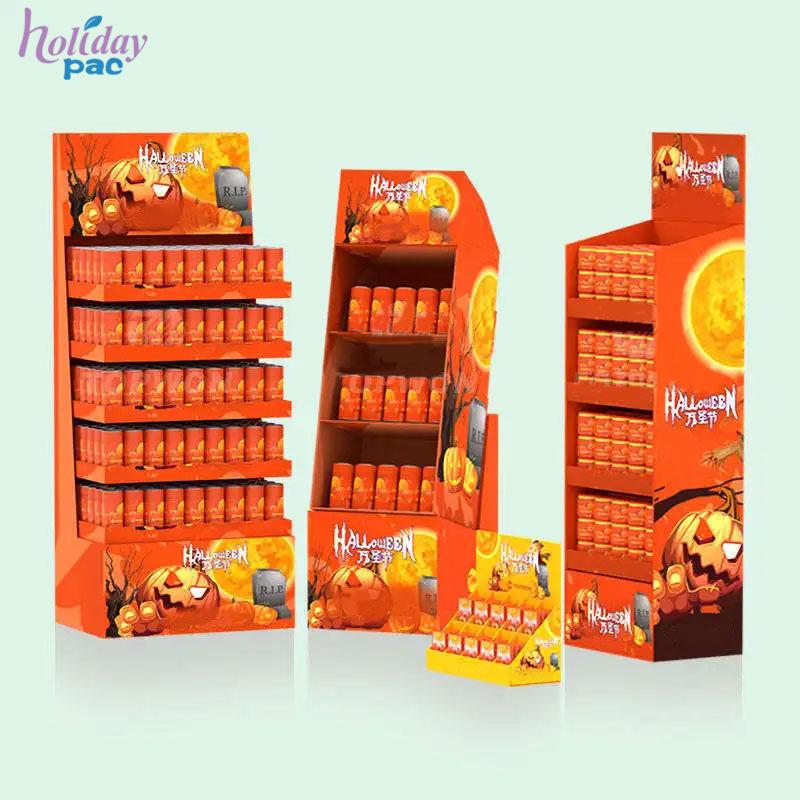
Seasonal programs like our Halloween floor display stands are fully recyclable after the promotion ends.
The fastest way to get a reliable price is to send complete information up front. Include:
With these details, our team can recommend the most cost-efficient structure, design the dieline, make a sample that is effectively free (the fee is refunded with your order), and give you a DDP price delivered to your door. Contact Holidaypac to start your project.
It depends mainly on the display type, product weight, printing, and order quantity. At Holidaypac, most custom cardboard displays cost US$10–30 per unit. Counter displays are the most affordable, while floor and pallet displays sit at the higher end. Ordering larger quantities lowers the unit price because fixed costs such as tooling and setup are spread across more units.
Easel cards and simple counter displays are the cheapest, because they use the least board and often consist of a single die-cut piece. PDQ trays are also economical because they double as the shipping case.
Simplify the structure to fewer parts, limit full-coverage printing to the most visible panels, supply print-ready artwork, order in larger runs, and choose DDP delivery so freight and duties are included in one price.
Yes. Holidaypac's MOQ is 200 units, and at that quantity a typical custom display costs a little over US$20 per unit. This lets brands test a display in a limited number of stores before a full rollout.
After the quote is confirmed and the sample fee is paid, Holidaypac provides the dieline. Once your artwork is placed on the dieline and sent back, a printed sample is ready in about 3–5 days. The sample fee is refunded in full when you place your production order.
They can be, when made from traceable, deforestation-free board. Using FSC-certified materials is one of the most practical ways to document EUDR compliance for displays shipped into the European Union.


Links