Holidaypac
  Oct 06,2026
Retail display assembly starts before the first carton reaches a store. Buyers need to agree on the component set, folding sequence, product loading and shipping format while the display is still being developed. A printed panel may look correct on its own, yet a missing support, unclear instruction or unsuitable carton can create extra work during a retail rollout.
This guide focuses on assembly preparation and cardboard display packaging for brands, distributors and retail procurement teams. The five Holidaypac workshop photographs below show shaped board components, printed parts and carton handling. They illustrate production activity; the checklist explains the order-specific details buyers should confirm.
What needs to be agreed before retail display assembly?
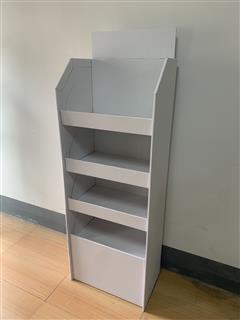
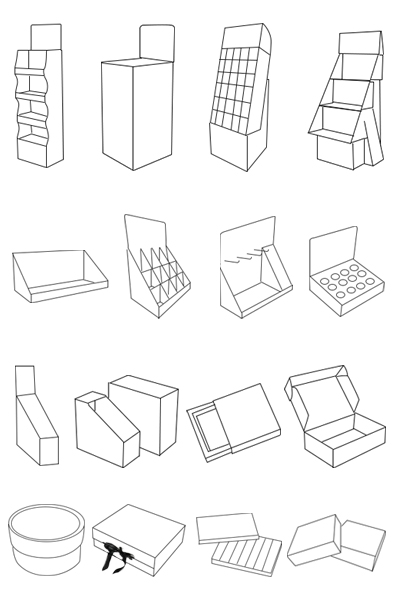
Start with where the display will be assembled and who will load the products. A factory, distribution centre and individual store have different working conditions. A floor unit may need a base, shelves, supports and a header; a counter display may need fewer parts but still require the right folding and locking sequence.
Ask for a component list linked to the approved structural drawing. Specify which parts arrive folded, which remain flat, and whether accessories are packed separately. If your team is comparing corrugated display manufacturers, request evidence of the proposed assembly method as well as printed artwork. This makes the quotation more useful than a price for an undefined structure.
1. Identify shaped panels and their assembly roles
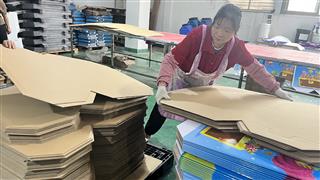
In the photograph below, a workshop operator handles a shaped board component beside stacks of similar parts. Its precise function cannot be identified from the photograph alone. For an actual order, each panel should have a clear place in the drawing and assembly sequence.
Review folds, tabs, slots and the intended print orientation on a structural sample. Check whether two similar-looking pieces can be confused and whether left and right components need different identification. Ask a person unfamiliar with the design to follow the instructions. Record any step where they hesitate, force a tab or place a panel backwards.
2. Match printed components to the correct display version
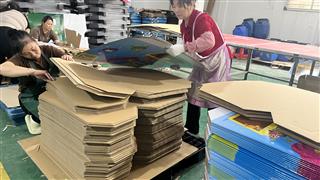
The next photograph shows staff handling board parts at a worktable, with printed pieces nearby. Multiple graphic versions can look similar when stacked. For a programme with several brands, languages or promotional campaigns, agree how each version will be identified throughout packing.
Use a project reference and artwork revision that connect the approved proof, component list and carton label. Confirm which graphics belong on the header, side panels and shelves. Review the assembled sample from the shopper’s viewing angle so text is readable and key images are not hidden behind products.
3. Plan component stacking and kit completeness
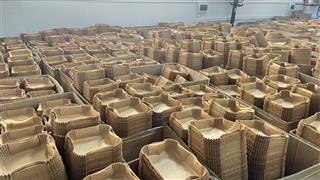
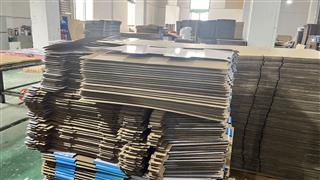
Stacks of shaped board pieces show how many individual components can be involved before a finished display is formed. A stack is not necessarily a complete kit. Buyers should distinguish the number of panels from the number of complete merchandising units in the shipment.
Agree quantities for each component and the number of complete displays per carton. If several cartons make up one unit, state that clearly on the packing list. Review how the board edges and printed faces will be protected, and whether heavy accessories could mark panels during transport. Confirm storage and handling requirements for your route rather than relying on a photograph to establish suitability.
4. Choose cardboard display packaging around the receiving operation
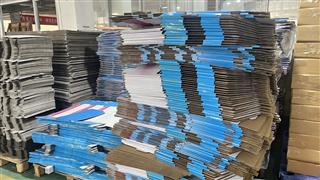
The following photograph shows stacks containing blue printed board components. It is useful context for discussing component grouping, but it does not establish that the pictured parts belong to one order or that the stacks are ready for dispatch.
For your project, compare flat, partially assembled and assembled packing using an actual sample. Flat packing can reduce the space occupied by the structure, while transferring assembly work to the receiving team. Assembled delivery can reduce setup tasks, but the packed dimensions and protection requirements may increase. The practical choice depends on your labour, freight and store rollout plan.
Measure the final outer carton, confirm the complete units per carton and record gross weight. If comparing freight quotations, use those agreed measurements. Do not assume a universal percentage saving from flat packing or a fixed assembly time for every structure.
5. Review the packed carton before shipment
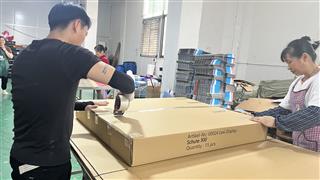
The final photograph shows workers handling a large carton on a table. Carton preparation is the last opportunity to check that the agreed components, instructions and accessories can travel together in the proposed format.
Open a representative packed sample and check it against the parts list. Assemble the display from that carton, following the instructions supplied, then load it with representative products. Review the carton closure, internal movement, label position and handling method. Agree any transport testing and acceptance criteria appropriate to the delivery route before mass shipment.
Retail display assembly approval checklist
- Structure: approved drawing, complete component list and correct assembly sequence.
- Product fit: representative pack dimensions, weight, arrangement and visibility.
- Graphics: approved artwork revision and readable panels on the assembled display.
- Kit: correct component quantities, accessories and usable instructions.
- Carton: packing format, outer dimensions, gross weight and complete units per carton.
- Receiving: named assembly location, product-loading responsibility and carton identification.
- Acceptance: agreed sample approval, inspection records and project-specific testing.
Keep retail display fulfillment responsibilities clear
A complete rollout can involve display manufacturing, assembly, product loading, storage and delivery to individual stores. These are separate responsibilities. Confirm who supplies the merchandise, who loads it, and which party handles destination storage or distribution. Ask for each required service to be stated in the quotation; do not assume a manufacturing order includes overseas warehousing or store delivery.
For wider production context, read Inside Holidaypac Custom Packaging and Display Production. For artwork approval, see Packaging Printing Quality Control. This assembly checklist adds the practical details needed between approved components and a usable retail unit.
Buyer FAQ
What is retail display assembly?
Retail display assembly means putting display components together into the agreed merchandising structure. For cardboard displays, this can include folding panels, fitting shelves or dividers, and securing headers or accessories according to the approved design.
Should cardboard displays ship flat or assembled?
Choose the packing format around carton size, freight, assembly labour and the receiving location. Flat packing shifts more setup work to the destination; assembled delivery usually requires more shipping space. Compare an actual packing sample before deciding.
How can buyers reduce missing components?
Agree on a parts list, quantities per display, accessory packing and carton labels. Check a complete kit against the list and assemble a sample using only the contents supplied.
How long does cardboard display assembly take?
Assembly time depends on the approved structure, accessories and operator experience. Time a representative trial and confirm the instructions rather than applying one fixed time to every display.
Can a workshop photograph confirm load capacity?
No. Load capacity should be agreed for the specific structure and supported by a suitable test using representative products and the intended loading arrangement.
What should I send Holidaypac for an assembly and packing quotation?
Send the product dimensions and weights, display format, quantity, artwork, destination, required delivery date and preferred packing method. Include retailer instructions and clarify who will assemble and load the units.
Discuss your cardboard display project with Holidaypac
Holidaypac manufactures custom paper packaging and cardboard retail displays for business buyers. Send your product photographs, dimensions and weights, preferred display format, quantity, artwork and destination. Include your assembly location and packing preference so the discussion covers both the display design and how your team will receive and set it up.
A clear brief helps align the structure, printed components and packing method with the needs of your retail programme.