Holidaypac
 Oct 02,2026

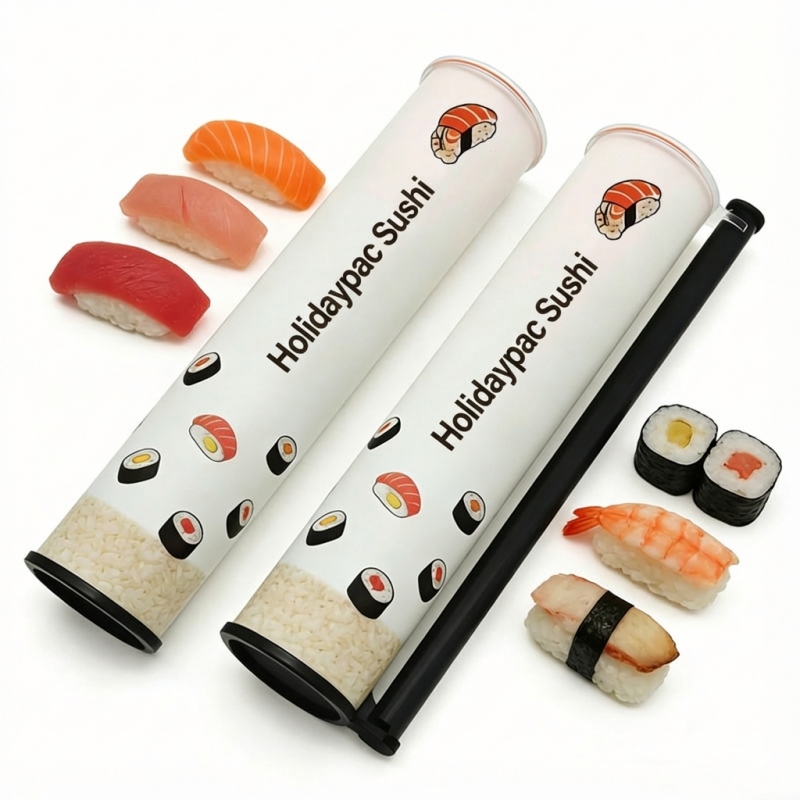
Push pop sushi packaging puts a sushi roll inside a tube with a movable base. The customer removes the lid and pushes from below to raise the roll as they eat. For a restaurant, takeaway brand, or packaging distributor, the important question is simple: does the tube work reliably with the sushi you actually sell?
An attractive printed sample is only the starting point. Before placing a bulk order, check the relationship between your roll, the inner tube, the lid, and the push mechanism. This guide explains a practical sample-testing process and the information to include in a packaging brief.
A conventional sushi box holds several pieces on a flat base. A push-up tube holds the food vertically and depends on a sliding base to present it. That means the package must fit the food closely enough to support it, while leaving enough room for movement.
Too much space may let the roll move during transport. Too little may make pushing difficult or damage the roll. There is no single tube size that will suit every recipe. Start with your menu and confirm the fit using filled samples.
If you are comparing packaging formats, see our sushi packaging guide covering push pop tubes and boxes.
Measure several rolls made during normal service. Record their diameter, length, and weight after preparation. Include the largest and smallest examples, rather than sending the supplier only one average measurement.
Ask whether the quoted tube dimensions are internal or external. Internal diameter is the usable space available to the roll. External diameter includes the wall and matters for cartons, labels, and storage. Confusing these measurements can lead to a sample that looks correct on paper but does not fit in practice.
I would keep one measurement sheet for each menu item. A small roll and a generously filled roll may need different packaging, even if their product names sound similar.
Use the same ingredients and preparation method planned for commercial service. An empty tube, a dry substitute, or a carefully selected demonstration roll cannot show how the package behaves across your normal production range.
Load each sample using the intended filling method. Fit the lid, hold the tube as a customer would, then raise the food in small steps. Check whether the base moves smoothly and whether the roll stays intact. Try the process with multiple staff members, so the result does not depend on one experienced operator.
Record problems precisely. “Hard to push” is less useful than “the base moves freely when empty but catches after the largest roll is loaded.” Photos and a short video can help the supplier identify whether the issue is fit, assembly, or the mechanism.
Ask the supplier to identify every component included in the quotation. Confirm the tube body, lid, movable base, and any separate push component. Request an assembly drawing or demonstration if the mechanism is unfamiliar.
The lid should stay in place during the handling conditions you test, yet be manageable for the customer to remove. Check that staff can distinguish the top from the bottom and that the push direction is clear. A simple illustrated instruction may be more useful than a long paragraph printed on the package.
Do not assume the tube is leakproof. If sauce is part of your offer, test the intended serving arrangement. A separate sauce container may be appropriate, depending on the package design and your service method.
Packaging needs to work in the kitchen and on the journey to the customer. Time a small filling run and record the steps: preparing the package, inserting the food, closing the lid, applying a label, and placing units in a delivery carrier.
Then test the proposed delivery arrangement. Check upright and tilted handling, movement inside the carrier, lid retention, and the condition of the food when opened. Use the storage and delivery conditions established for your operation. Packaging is not a substitute for your food-handling controls.
Keep the results in a simple sample log:
| Check | What to record |
|---|---|
| Roll fit | Recipe, measured diameter, length, and sample ID |
| Push action | Smooth movement, sticking, or damage to the roll |
| Lid retention | Any opening or loosening during the handling trial |
| Filling workflow | Steps, time, and assembly difficulties |
| Arrival condition | Movement, staining, deformation, and customer usability |
Agree on acceptance criteria before approving the final sample. Keep an approved reference sample so later deliveries can be compared with the same specification.
Request a description of the materials used in each component, including any inner lining or coating. Ask the supplier for documentation relevant to the intended food contact and destination market. Make sure the documentation corresponds to the construction you are ordering; a general company certificate does not describe every possible package.
Confirm what the inner surface is intended to withstand and validate it under your actual filling conditions. Do not infer complete water resistance, recyclability, or compostability from the appearance of a paper tube or the name of a coating.
For custom printing, ask for the artwork template, printable area, seam location, and areas that must remain clear. Keep essential instructions readable. Check the final printed proof with the lid fitted, because a design that looks balanced on a flat template may be partly covered after assembly.
A useful quotation starts with a defined package. Send the supplier your measured roll range, intended portion, preferred construction, destination, quantity, and artwork requirements. Include photos of the food and explain how the package will be filled and delivered.
Ask the supplier to state the minimum order quantity, sampling charges, production lead time, and shipping basis separately. These depend on the specification and order; avoid comparing two prices until you know they include equivalent components and services.
Our sushi push pop tube packaging buyer’s guide provides a broader starting point for sourcing. Use this testing checklist alongside it when you move from browsing options to approving a sample.
Do not assume so. Compare your smallest and largest finished rolls with the proposed internal dimensions and test filled samples. You may decide to standardize the food portion or use more than one tube size.
Photos can help review appearance and printing. They cannot establish how the movable base performs with your food. Request physical samples before committing to a commercial specification.
Send your roll dimensions, photos, requested quantity, printing requirements, destination, and preferred delivery timing. State which components you need and whether the first order is a trial or a planned repeat program.
Good push pop sushi packaging should suit the roll, the filling workflow, and the customer’s handling experience. Define those requirements before choosing the final artwork or committing to volume.
Contact Holidaypac through our website with your product measurements and packaging brief. Ask for a proposed tube specification and sample options, then validate the package with your own sushi before bulk ordering.


Links