Holidaypac
 Apr 27,2026

A factory-floor breakdown of food-grade PP vs PVC, LFGB certification, FSC paper engineering, and the structural details that separate a viral sushi tube from a soggy disappointment. Written for restaurant brand owners, procurement managers, and packaging buyers shopping the world's hottest food trend.
Hello — I'm Cassie Lan, founder of HolidayPac®. For more than twenty years I have lived inside one industry: paper-based packaging and retail display. I started HolidayPac in 2010 because I saw a gap in the market for environmentally responsible packaging produced at the same quality level as luxury cosmetic boxes. Today our factory ships custom sushi tubes, cardboard displays, FSDUs, PDQ trays, and branded retail packaging into more than forty countries.
If you are reading this, you already know that the sushi push pop tube — also called a sushi pop, push-up sushi, sushi pop-up container, or tube sushi — is the most talked-about food packaging format of 2026. The hashtag #sushipushpop has crossed tens of millions of views on TikTok and Instagram. Sushi shops in Los Angeles, Toronto, London, and Sydney have reported double-digit lifts in monthly revenue after switching to tube format.
And yet, when I open the sushi tube samples our potential clients send me from other suppliers, I see the same disappointing pattern again and again: tubes that lean rather than stand up, lids made of PVC instead of food-grade PP, sauce plugs made of unregulated rubber, and cardboard walls so thin you can fold them between two fingers. This article is a frank, factory-floor buyer's guide.
Before we get into the engineering, let's talk about why this product matters commercially in 2026. In my experience three or four trends have to converge for a packaging format to "go viral." All four are converging right now for sushi push pop tubes.
Short-form video has rewired how Gen Z and Millennial consumers discover restaurants. The push-up motion of a sushi tube — twist the cap, push the plunger, watch a perfectly layered roll rise out of the cylinder — is engineered for fifteen-second video. The packaging is the marketing.
Consumers eat in cars, in parks, on commuter trains, at office desks. Traditional bento-style sushi boxes need a flat surface, chopsticks, soy sauce containers, and napkins. A push pop tube needs one hand and ninety seconds.
The sushi push pop tube delivers this perfectly: the food is sealed inside the cylinder until the moment of consumption, and the bottom plunger means you eat from the top without your hand ever contacting the rice or fish.
In 2026, "eco-friendly" is not a marketing claim, it is a procurement requirement. Paper-based push pop tubes — properly engineered — are dramatically more sustainable than the plastic clamshells and Styrofoam trays they replace.
A sushi push pop tube is a cylindrical, paper-based food container with a movable internal base. The customer twists off the top cap, presses the plunger at the bottom, and the sushi roll rises smoothly out of the top of the cylinder, ready to be bitten. No chopsticks, no plate, no soy sauce dish.
Each of these five components has a "cheap version" and a "right version." Most of the time, when buyers ask me to quote against a competitor sample, the competitor has cut corners on three or four out of five.
The very first thing I check when a competitor sample lands on my desk: place the tube on a flat table. Does it stand straight up, or does it lean to one side? It sounds trivial. It is not. The tube's posture on the shelf is the first non-verbal signal your customer receives about your brand.
Our standard sushi push pop tube has an outer diameter of 53mm and a height of 220mm. The competitor tubes we benchmark against typically come in at 50mm × 220mm. That three-millimeter difference is the difference between a clean push and a squashed mess.
A standard maki roll sits at about 45-48mm in diameter. Inside our 53mm tube, that roll has 2.5-4mm of breathing room. In a 50mm competitor tube, the same roll is sliding against the wall, picking up rice on the way up.
| Specification | HolidayPac | Other Suppliers |
|---|---|---|
| Outer diameter | 53 mm | 50 mm |
| Height | 220 mm | 220 mm |
| Bottom lid + tray height | 1.8 cm | 2.5 cm |
| Effective interior space | +0.7 cm advantage | baseline |
| Cardboard wall thickness | 1.48 mm | 1.08 mm |
| Sauce tube weight | 9.2 g | 5.0 g |
Here is a detail that almost no procurement spec sheet captures, and it is the single most underrated difference: the height of the bottom assembly. On a HolidayPac tube it stacks to 1.8 cm. On a typical competitor tube it stacks to 2.5 cm. That 0.7 cm is interior space we give back to your sushi.
In a 220mm tall tube, 0.7 cm of extra interior space is roughly 3% more usable volume. That is one extra slice of cucumber, one extra piece of salmon, or the difference between a six-piece roll and a seven-piece roll.
This is the section I beg every single buyer to read carefully. The plastic components inside a sushi push pop tube come into direct, prolonged contact with raw fish, vinegared rice, and acidic sauces. The choice of plastic is not a cost decision — it is a food safety decision.
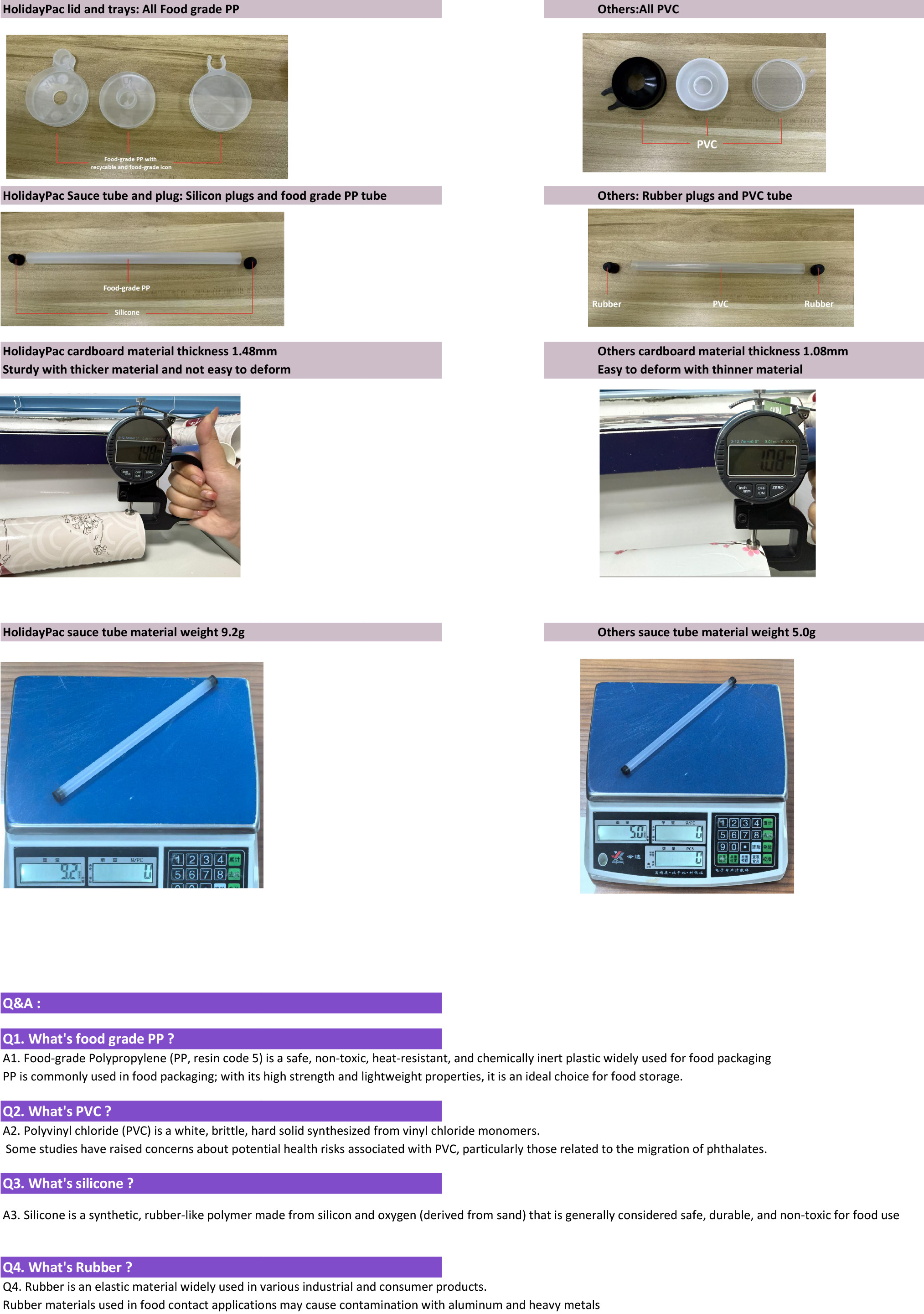
Food-grade Polypropylene (PP, resin identification code 5) is a safe, non-toxic, heat-resistant, and chemically inert plastic widely used for food packaging. PP is the same material used in yogurt cups, microwave-safe takeaway containers, and reusable water bottles.
Polyvinyl chloride (PVC) is a white, brittle, hard solid synthesized from vinyl chloride monomers. Some studies have raised concerns about potential health risks associated with PVC, particularly regarding the migration of phthalates. PVC tooling is cheaper and many small OEM factories simply have PVC presses sitting idle.
The sauce tube is sealed at both ends with a small plug. That plug has to be airtight enough to prevent leakage during shipping, flexible enough that the customer can pop it out with a fingertip, and chemically inert enough that it does not contaminate the soy sauce.
HolidayPac uses food-grade silicone plugs. Silicone is a synthetic, rubber-like polymer made from silicon and oxygen, generally considered safe, durable, non-toxic for food use, and stable across the full range of refrigeration to ambient temperatures. It is the same material used in baby bottle nipples and medical-grade tubing.
Other suppliers use unregulated industrial rubber plugs. Rubber materials used in food contact applications may cause contamination with aluminum and heavy metals if not specifically formulated for food use.
HolidayPac sushi tubes use 1.48mm wall thickness. Other suppliers run 1.08mm. That is a 37% difference in cardboard mass per tube. The HolidayPac tube has weight, density, and resistance to squeezing.
A thicker tube resists crushing in delivery bags (critical for ghost kitchens), holds its shape during the push, prints more vividly, and survives reuse for a few cycles. Many consumers genuinely keep our tubes as pen holders, desk organizers, or seed-storage canisters — that is free brand impressions in their home for months.
The inside surface of a sushi tube — the part that actually touches the rice — is critically important and almost never discussed in supplier specifications. Sushi rice is moist, slightly acidic from rice vinegar, and rich in oils. Bare paper would absorb all of it within minutes.
A thin aluminum foil bonded to the inside of the cardboard. It works as a moisture barrier, but aluminum has documented concerns about migration into acidic foods, it is non-recyclable in most paper streams, and it gives the inside of the tube a slightly metallic appearance.
A thin food-grade polymer film bonded to the inside of the cardboard. It provides a complete moisture and oil barrier, fully compliant with EU food contact regulations (EC 1935/2004), and verified by LFGB sensory testing not to affect taste or smell.
I weigh competitor sauce tubes on a calibrated scale every time a sample arrives. The numbers are remarkably consistent: HolidayPac sauce tubes come in at 9.2 grams. Other suppliers' tubes come in at 5.0 grams. That is nearly double the material.
The 9.2g tube is over-engineered on purpose. We use thicker food-grade PP, longer plug seats, and a slightly larger overall diameter, so the tube feels like a serious component rather than a flimsy afterthought. Customers perceive the heavier sauce tube as more premium and more trustworthy, which extends to the brand of the sushi inside.
Anyone can claim "food safe" on a marketing page. Buyers should require third-party verified test reports.
LFGB is Germany's Lebensmittel-, Bedarfsgegenstaende- und Futtermittelgesetzbuch — widely considered the strictest food-contact standard in the world. HolidayPac sushi push pop tubes have passed SGS testing under Regulation (EC) No 1935/2004, including:
Our SGS test reports for both the paper tube SKU (HLD-FP-ST-6) and the plastic accessories SKU (HLD-FP-ST-PP) returned a Pass result on every category. Reports dated March 2026, available to qualified buyers under NDA.
FSC certification verifies that the paperboard used in our cylinders comes from responsibly managed forests — a hard requirement for anyone selling into the EU, the UK, Australia, or major US retail chains.
Our tolerance on outer diameter is ±0.3mm. Our tolerance on cardboard wall thickness is ±0.05mm. Our reject rate on bottom plunger flatness is 1.0mm out-of-spec or worse.
Sushi push pop tubes are the most TikTok-friendly food packaging format I have ever shipped in twenty years.
The exterior of the tube is a 360-degree printable surface. Your logo should wrap around the entire tube. Add a hashtag. Add a QR code that links to your menu, your loyalty app, or a specific TikTok challenge.
The push-pop motion lasts about three seconds — one short-form video clip. This is why our 53mm diameter and our food-grade PP plunger matter — they produce a clean, smooth, photogenic push every time.
Twist off the top cap, pop the silicone plug from the sauce tube, drizzle, push, bite. That is a five-step ritual. Rituals get filmed.
The hashtags #sushipushpop, #pushpopsushi, #sushitube, #sushireels, #tubesushi, #asmrsushi already have collective billions of views. Print the hashtag directly on the tube wrapper.
Your sushi chefs are the best content creators you have. Show them how to film a fifteen-second push-pop reveal at the takeaway counter.
| Tube Size | Diameter × Height | Best Use |
|---|---|---|
| Single-serve mini tubes | 40mm × 150mm | Kids' menus, party catering |
| Standard maki tubes | 53mm × 220mm | Flagship sushi roll spec |
| Share-size tubes | 65mm × 250mm | Premium hand rolls, two-person platings |
| Party-size tubes | 80mm × 280mm | Catering boxes, event giveaways |
HolidayPac is structured to support both startups and large chains. Our minimum order quantity for a custom-printed tube SKU is intentionally low. Lead time on a fresh custom order is typically 25-30 days from artwork approval, including LFGB-tested batches.
Smaller sushi shops use the tube format to differentiate from larger chains. The packaging itself becomes a promotional tool — customers come in because they have seen the tube on TikTok.
QSR sushi chains use tube format for limited-time-offer (LTO) promotions. The format generates social buzz during the LTO window.
Truck operators love sushi tubes because they eliminate the need for plates, chopsticks, and napkins — three SKUs of disposable supply that take up cart space.
Catering companies serve sushi tubes as elevated finger food at weddings, corporate events, and trade shows. The vertical format displays beautifully on a buffet table.
The tube's vertical cylindrical shape fits cleanly into delivery bags, holds shape during transit better than flat boxes, and produces a memorable "moment of arrival" when the customer opens the bag.
Major retailers in Japan, Korea, and increasingly in Europe and North America are testing sushi tubes in chilled grab-and-go cases. The vertical format saves shelf space versus horizontal trays.
Print this checklist. Take it to every sushi tube quote. Score each supplier honestly. The supplier that scores 12/12 is the supplier you trust with your brand.
Q1. What is food-grade PP, and why does it matter for sushi tube packaging?
Food-grade Polypropylene (PP, resin code 5) is a safe, non-toxic, heat-resistant, and chemically inert plastic widely used for food packaging. With its high strength and lightweight properties, it is an ideal choice for food storage. HolidayPac uses 100% food-grade PP for every plastic component — caps, trays, plungers, and sauce tubes.
Q2. What is PVC, and why should buyers avoid it?
Polyvinyl chloride (PVC) is a white, brittle, hard solid synthesized from vinyl chloride monomers. Some studies have raised concerns about potential health risks associated with PVC, particularly those related to the migration of phthalates. HolidayPac never uses PVC for any food-contact part.
Q3. What is silicone, and why is it better than rubber for sauce plugs?
Silicone is a synthetic, rubber-like polymer made from silicon and oxygen (derived from sand) that is generally considered safe, durable, and non-toxic for food use. Industrial rubber materials may cause contamination with aluminum and heavy metals if not specifically food-rated.
Q4. What are the standard dimensions of a HolidayPac sushi push pop tube?
Standard outer dimension is 53mm diameter × 220mm height. The bottom assembly (lid + tray) measures 1.8cm, leaving 0.7cm more interior space than typical 2.5cm competitor designs. Custom dimensions are available for single-serve mini, share-size, and party-size tubes.
Q5. Are the tubes microwave-safe or freezer-safe?
The tubes are designed for refrigerated and ambient-temperature display (1-4°C). They are not designed for microwave heating. Food-grade PP itself is freezer-safe.
Q6. What is the typical MOQ and lead time?
MOQ is intentionally low to support startups and independent sushi shops alongside global chains. Lead time on fresh custom-printed orders is typically 25-30 days from artwork approval. Free physical samples are shipped to qualified buyers worldwide within 5-7 working days.
Q7. Can the tube hold non-sushi foods?
Yes. We have shipped variants for poke layered bowls, fruit cups, granola layered breakfasts, savory rice cups, and even cocktail garnish kits.
Q8. How does shipping work, and do you handle EU/UK/US import compliance?
We ship FOB Shenzhen by default. Customers in the EU, UK, US, Canada, and Australia routinely import our tubes under standard food-packaging HS codes. Our LFGB and FSC certifications cover the major regulatory requirements.


Links