Holidaypac
 Jul 01,2026

By Cassie - Founder of Holidaypac | 20-Year Expert in Paper Packaging & Displays
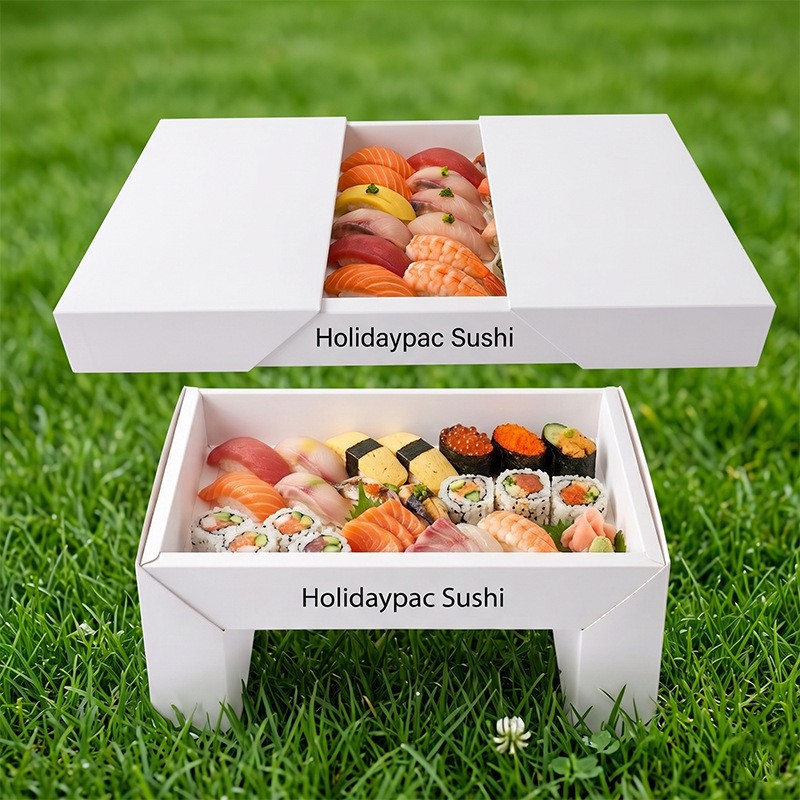
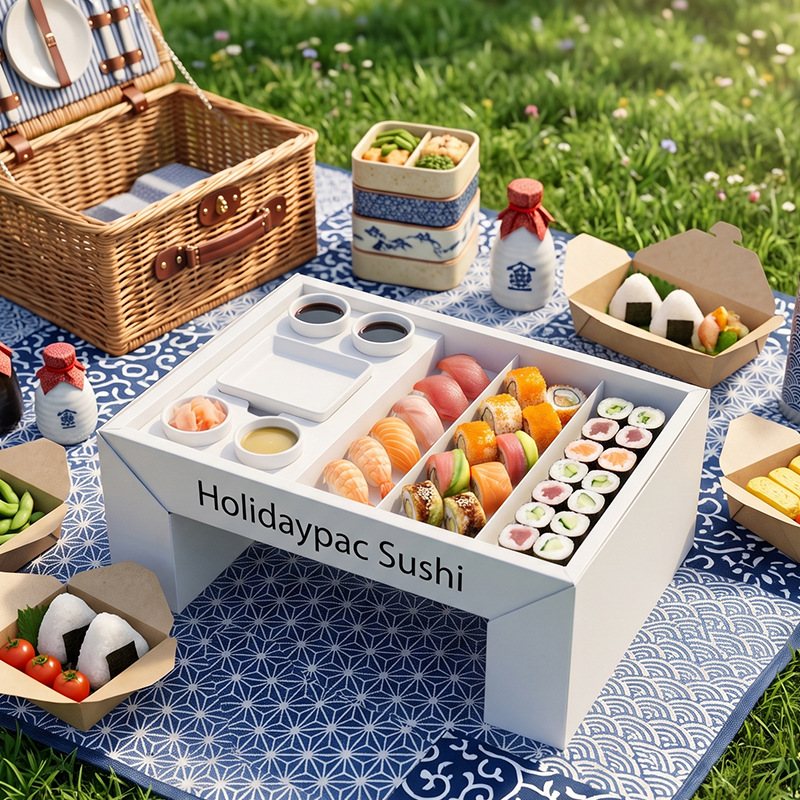
A custom pull-out and flip catering sushi tray with leg stand is designed for foodservice buyers who need a packaging format that performs in two moments: during transportation and during presentation. The pull-out structure helps separate and reveal food neatly, the flip function improves serving convenience, and the leg stand raises the tray for a stronger catering display. When sourced from a factory such as Holidaypac, the key buying points are material safety, tray stiffness, fold accuracy, leg stability, custom printing, sample approval, bulk packing strength, and clear communication about food contact requirements.
Modern sushi catering has a different packaging challenge from standard takeout. A normal flat tray may work for a single order, but catering orders are judged by a larger audience. The packaging must survive transport, open cleanly, display the food attractively, and help the serving team move quickly. A custom pull-out and flip catering sushi tray with leg stand is built for this exact situation: it combines protective packaging with a display-ready serving structure.
Procurement teams often tell us that the real problem is not only price. Their concerns are more practical. Will the tray stay stable when loaded with sushi rolls, sashimi, garnish, and sauce cups? Will the legs open evenly? Will the pull-out action feel smooth enough for event staff? Can the tray be stacked for transport without crushing the food? Can the package be customized with the restaurant logo, supermarket private label, or catering brand color? Can the factory keep size, color, and folding tolerance consistent from one production batch to the next?
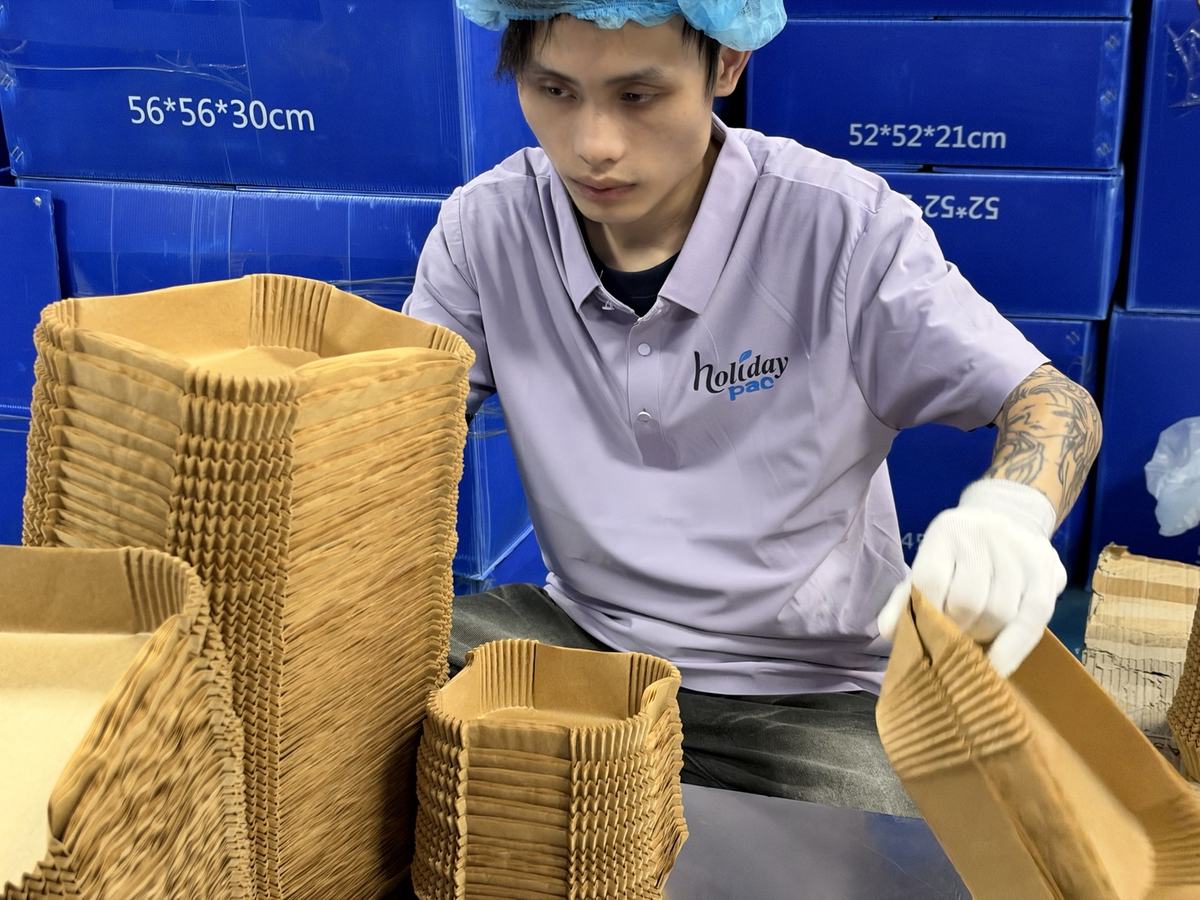
Holidaypac designs and produces paper food packaging for global buyers, including sushi boxes, catering boxes, bakery boxes, and other custom food packaging. For a tray with moving parts, folding lines, and display legs, factory experience matters. The structure must be considered before printing, and the printing must be considered before cutting. If the design looks beautiful but folds poorly, the buyer still loses money. If the tray folds correctly but does not present food elegantly, the brand loses impact.
Foodservice packaging trends also push buyers toward better documented and more responsible materials. In the United States, the FDA explains that food contact substances include packaging and its components when they contact food. In the European market, the Packaging and Packaging Waste Regulation 2025/40 entered into force on February 11, 2025 and will generally apply from August 12, 2026. Buyers should confirm final compliance requirements with their own legal or compliance teams, but the direction is clear: packaging decisions need stronger material thinking, better documentation, and less wasteful design.
A pull-out and flip catering sushi tray is not a simple box with a lid. It is a functional display system. The pull-out section can be designed as a drawer, sliding tray, or layered reveal format. The flip function may help the lid become a presentation panel, a serving support, or a protective cover that opens cleanly. The leg stand raises the tray from the table, giving a more premium buffet appearance and helping the food stand out during events.
For buyers, the first structure question is load. Sushi is visually delicate but can be heavy when ordered in catering quantities. Rice, fillings, seafood, garnish, and sauce containers add weight. If the paperboard is too thin, the tray bends. If the folding line is weak, the legs may wobble. If the sliding clearance is too tight, the pull-out section may jam after cold storage or humid transport. If the clearance is too loose, the tray may feel cheap or unstable. A factory should test the structure using realistic loading, not only an empty sample.
The second structure question is event workflow. In a restaurant kitchen or catering prep room, staff need quick packing. At the event, staff need quick setup. A good custom tray should reduce manual handling. The pull-out and flip format can allow the food to remain protected during transportation, then transform into a clean display without transferring sushi onto another platter. This reduces labor, helps hygiene, and lowers the chance of damaging the food presentation.
The third structure question is storage and shipping. A premium tray with legs may look beautiful, but if it ships with too much air volume, freight cost becomes painful. Holidaypac engineers the folding method, carton packing, and assembly logic together. For many buyers, the best solution is a tray that ships flat or semi-flat, assembles quickly, and still feels solid after opening. This is where a packaging factory can create value that a trading-only supplier may miss.
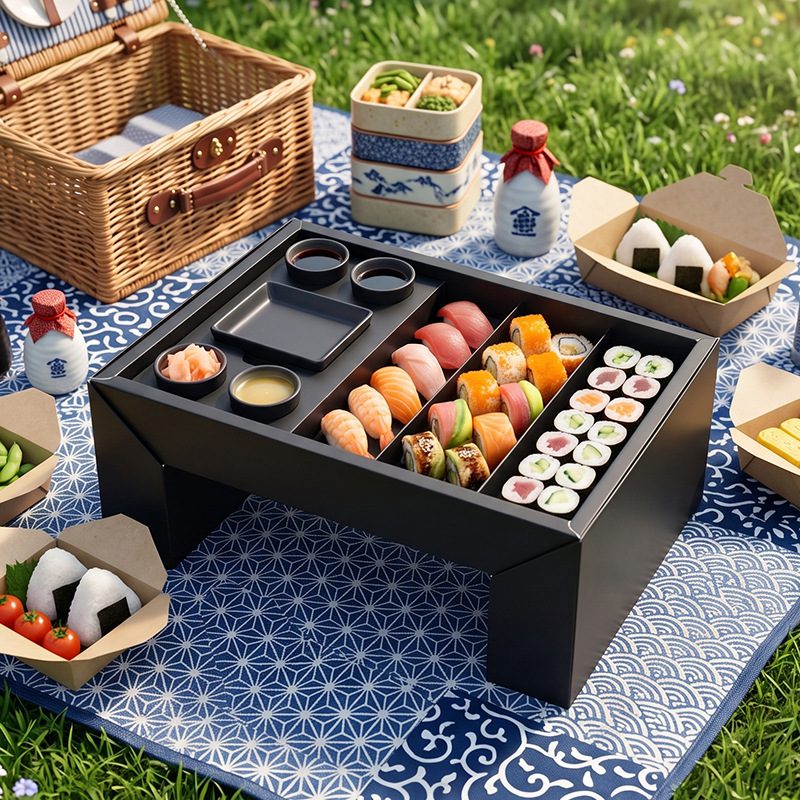
Material selection for a catering sushi tray must balance safety, stiffness, visual quality, and cost. Buyers often ask for kraft paperboard because it communicates natural value and works well for eco-conscious food brands. White paperboard may be preferred for clean Japanese food presentation and high-end printing. Coated paperboard, laminated board, or food-grade inner surfaces may be considered depending on direct food contact, moisture level, oil exposure, and cold chain use.
Because sushi may include rice moisture, seafood, sauce, and garnish, the contact surface should be discussed clearly before sampling. Is the sushi placed directly on the tray? Will there be a liner, inner pad, PET window, or separate food-contact film? Will the tray hold chilled food only, or will it contact warm items? Will the package be refrigerated, transported in insulated boxes, or displayed at room temperature for a short event window? These details influence board grade, coating, glue, ink, and testing documents.
Holidaypac helps buyers translate the use scene into packaging specifications. For example, a supermarket deli program may need strong barcode and private label printing, while a wedding catering supplier may care more about premium texture and fast setup. A restaurant chain may need stable color matching across multiple branches. A distributor may need a size range that fits several customer segments. A hotel banquet supplier may request elegant white, kraft, or soft purple brand accents that match table styling.
Buyers should ask for material declarations and relevant food contact documentation based on their market. FDA resources are useful for understanding U.S. food contact substances, while EU buyers need to watch packaging and packaging waste requirements as well as food contact rules applicable to their exact material. Holidaypac can support documentation discussions, but final market approval should always be confirmed by the buyer's compliance team.
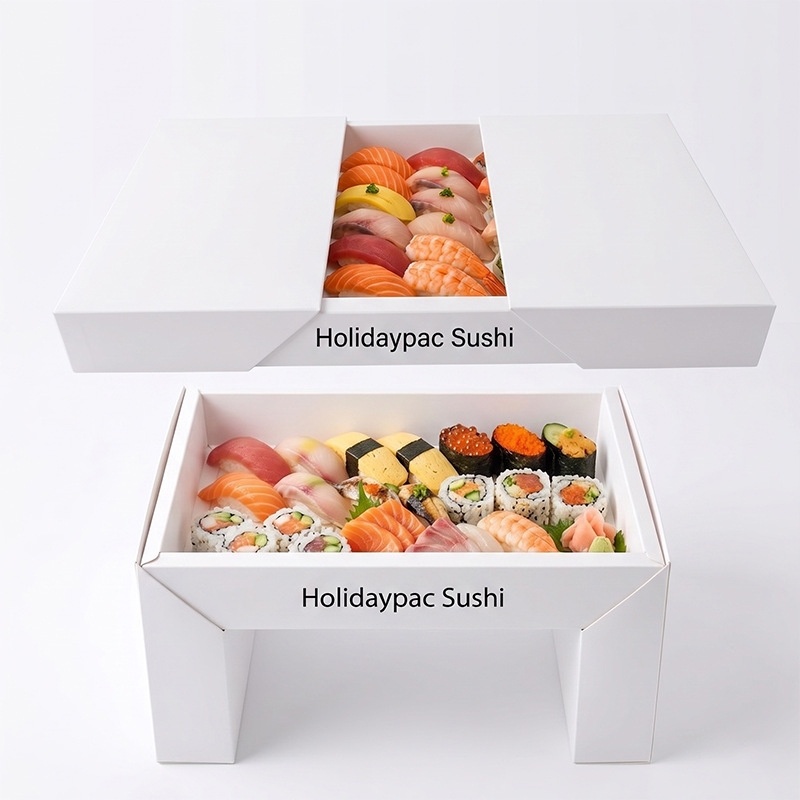
A catering sushi tray is seen in photos, on buffet tables, in office events, in supermarket catering counters, and sometimes in social media posts. That means custom printing is not decoration only. It is a brand touchpoint. A buyer can use the tray to communicate freshness, Japanese food quality, premium catering, sustainable packaging values, or private label identity.
For a custom tray, this color can be used as a brand accent on the outer sleeve, inside flip panel, side wall, instruction icon, or seal area. For food presentation, we recommend using it with warm white, kraft brown, fresh green, or soft blue instead of overwhelming the tray with one heavy color. Sushi needs visual freshness; the tray should support the food, not compete with it.
When developing artwork, buyers should request a dieline from the factory before finalizing design. A pull-out and flip structure has fold lines, glue areas, sliding sections, and leg panels. Important logos should not cross weak fold points unless the effect is intentional. QR codes, barcodes, allergy notices, disposal marks, and heating or storage instructions should be placed in stable areas. For catering use, a small setup instruction icon may also help staff open the tray correctly.
Printing methods may include offset printing, flexographic printing, digital sampling, spot color matching, matte or gloss finishes, and optional surface treatments. The choice depends on quantity, color accuracy, budget, and lead time. For premium private label projects, buyers should approve both a digital proof and a physical pre-production sample. A screen image cannot fully show paper texture, fold behavior, or color shift after coating.
As a factory, Holidaypac focuses on practical development steps, not only catalog sales. For a custom pull-out and flip catering sushi tray with leg stand, the project usually begins with the buyer's use case. We ask about food layout, tray size, serving quantity, target market, storage condition, print design, carton packing, and launch schedule. If the buyer already has a reference sample, we review what works and what needs improvement. If the buyer starts from an idea, we help convert the idea into a structure and quotation path.
The first stage is concept and size confirmation. A 24-piece sushi catering tray, for example, may need a different support design from a smaller party tray. A tray designed for supermarket display may need stacking strength. A tray designed for luxury catering may need a more refined opening experience. Buyers should not choose a size only by visual guess. The best approach is to define food count, food dimensions, extra space for garnish, and carton packing target.
The second stage is material and structure sampling. Holidaypac can create samples to test folding, sliding, leg stability, and presentation. Buyers should test the sample with real food weight or a realistic substitute. They should open and close the pull-out part several times, place it on different table surfaces, and observe whether the legs remain stable. They should also check whether staff can assemble it quickly without special tools.
The third stage is artwork adaptation. Once the dieline is approved, artwork can be fitted to the structure. The design should include bleed, safe zones, barcode areas, logo position, and any compliance text required by the buyer. For brands that also purchase custom drawer sushi kraft boxes or OEM take-away sushi bento boxes, Holidaypac can help keep a consistent packaging language across product lines.
The fourth stage is pre-production confirmation. This is where buyers should approve physical color, paper feel, folding accuracy, leg strength, tray flatness, and carton packing. After bulk production starts, changes become expensive. A careful approval process saves time and prevents disputes.
The solution is load testing. Ask the factory to confirm board thickness, reinforcement logic, folding direction, and weight-bearing performance. Test with food weight, not only empty packaging. The leg stand should be evaluated on a flat table, a buffet tablecloth, and a slightly uneven surface.
This may come from poor cutting tolerance, humidity influence, board swelling, or a clearance design that is too tight. A good sample should slide smoothly while still feeling controlled. For bulk orders, ask the factory about die-cutting accuracy and quality inspection for moving sections.
Provide brand color references, but remember that RGB is for screens. For printed packaging, convert the color to CMYK or Pantone guidance and approve a physical sample. Holidaypac can use the Holidaypac-style soft purple direction, such as RGB (181, 139, 191), as a gentle accent, but the final print should be checked under real lighting.
Ask for carton dimensions early. A beautiful display tray must still be efficient to ship. Flat-pack or semi-flat designs may reduce volume. The right balance depends on assembly time, shipping cost, labor cost, and the premium value of the final presentation.
Buyers should clarify whether food touches the tray directly and which market the product enters. Then ask for material information and relevant test reports where applicable. For U.S. buyers, FDA food contact substance resources are important references. For EU buyers, packaging waste and recyclability discussions are becoming more important because PPWR application is approaching.
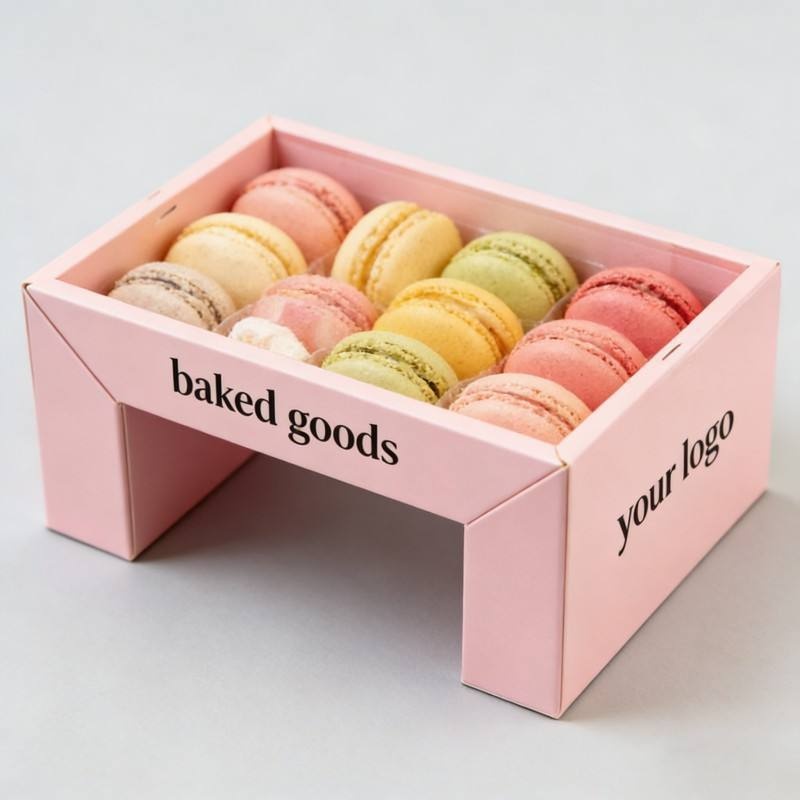
A catering sushi tray is handled by several people before the final customer sees it: factory packers, distributors, restaurant staff, drivers, event teams, and consumers. Good design respects all of them. The carton should be easy to count. The tray should be easy to assemble. The pull-out part should guide the hand naturally. The flip panel should not block food visibility. The leg stand should open without confusion. When these small details are right, the buyer's operation becomes smoother.
This is where Holidaypac's cultural approach to packaging becomes practical. Paper is simple, original, ancient, valuable, natural, and close to daily life. It is born from nature and should return closer to nature. Cassie Lan, founder of Holidaypac, often connects packaging design with balance: protection and beauty, cost and value, efficiency and emotion. Inspired by ideas such as harmony between people and nature, Holidaypac develops food packaging that is useful first, then beautiful in a restrained way.
For sushi, restraint is important. The tray should not shout louder than the food. It should frame the sushi, protect the arrangement, and create a clean moment when the customer opens it. A small brand color, a neat structural reveal, a stable raised display, and a pleasant paper texture can create emotional value without adding unnecessary complexity.
Holidaypac is a packaging factory and brand partner for buyers who need more than a generic tray. We understand that a custom pull-out and flip catering sushi tray with leg stand must be engineered, printed, packed, and delivered as a repeatable product. Our team supports structure discussion, material selection, sample development, artwork adaptation, and bulk production control.
Many buyers who source sushi trays also need connected packaging products, such as one-piece molded sushi boxes, fast food boxes, grazing boxes for catering, bakery boxes, and air fryer paper liners. Building these product lines with one factory can improve color consistency, packaging style, communication efficiency, and export coordination.
For distributors, Holidaypac can help create a sellable packaging range. For restaurant chains, we can support brand consistency. For supermarket private labels, we can focus on shelf appearance and carton packing. For catering companies, we can prioritize setup speed and presentation. For importers, we can discuss MOQ, mixed orders, documentation, and shipping efficiency.
Cassie Lan founded Holidaypac with 20 years of international trade experience and 16 years of packaging focus. Her view is that packaging should protect food, create visual impact, carry culture, and give consumers emotional value. For sushi catering trays, that means we should think about more than the outer shape. We should think about the rhythm of opening, the calmness of paper texture, the balance of color, and the trust created by a clean structure.
Chinese cultural thinking often values timing, harmony, restraint, and relationship between people and nature. In packaging terms, this becomes practical judgment: use enough material but avoid waste, make the structure strong but not heavy, make printing memorable but not noisy, and make the buyer's operation easier instead of more complicated. Born from nature and return to nature is not a slogan only; it is a design direction for better paper food packaging.
If you are sourcing a custom pull-out and flip catering sushi tray with leg stand, prepare your target size, food count, order quantity, market, logo file, and preferred material. Holidaypac can help review the structure, recommend material options, and develop a sample for your catering, deli, restaurant, or distribution program.
It is a custom food packaging and serving tray designed for sushi catering. The pull-out section helps reveal or separate the food, the flip structure improves opening and presentation, and the leg stand raises the tray for a more attractive catering display.
Yes. Holidaypac can discuss custom dimensions, food layout, paperboard grade, printing, logo placement, brand color, structure, and carton packing based on your order quantity and target market.
That depends on the chosen material, coating, liner, and use condition. Buyers should clarify whether sushi touches the tray directly and request appropriate food contact documentation for their market.
Test the sample with realistic food weight, check pull-out movement, open and close the flip structure, confirm leg stability, review print color, and evaluate carton packing. Use real event workflow if possible.
Share target size, food count, material preference, printing requirements, quantity, destination country, packing preference, sample deadline, and any compliance documentation requirements.


Links